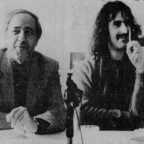
Libération - January , 1984
Linked material:
|
|
Linked material: |
| Italiano Español Français | Italiano Español Français |
Interview by Philippe Olivier and Patrice Bollon | |
|
| Zappa-Boulez, same fight? |
| Reverse translation from French |
| A huge crowd gathered tonight at the Théâtre de la Ville, where Pierre Boulez will conduct three works by Frank Zappa “in the presence of the composer”, who gave us an exclusive interview. A journey through his appreciation for certain 20th century composers, his very Anglo-Saxon sense of humor, and his constant desire for recognition: “I’ve been composing serious music since I was 14”… |
| Zappa/Boulez: For most French critics, the meeting between the Californian rock star, a leading figure in 60s progressive rock, and the charismatic composer and conductor has been a surprise, almost a scandal. As soon as the announcement was made, the Ensemble intercontemporain was inundated with phone calls. People wanted to see the scores. They even doubted their existence. They wondered about Zappa’s motivations - a desire for recognition or publicity? - and those of Boulez… |
| These attitudes stem primarily from ignorance. This isn’t the first time Zappa’s music has been performed by a “serious” ensemble. The distinguished, mustachioed musician had already been accompanied by the Royal Philharmonic Orchestra in his film-opera “200 Motels”. There he even quoted Berg’s Wozzeck! Last year, Los Angeles Philharmonic conductor Zubin Mehta included some of his works in his “Music of the 20th Century” program. Finally, a first volume of Zappa’s symphonic works, performed by the London Symphony Orchestra, has just been released. |
| There’s also a secret disdain in this lack of understanding by the critique. In France, people still don’t understand that one can love both classical music and rock. |
| Those who consider themselves cultured can’t imagine that another form of culture could exist. And vice versa. The worlds of so-called “serious” music and rock never intersect, according to the laws of a reductive Cartesianism. This isn’t the case in the United States, where Terry Riley could play with John Cale. Likewise, isn’t Philip Glass very close to rock experimentation? |
| Those who criticize these meetings should be reassured by tonight’s concert. Because, essentially, there’s no one more classical and wiser than Zappa when he composes for a traditional orchestra. A hint of Stravinsky, Berg and Varèse, mixed by a neoclassic sauce: there’s nothing to scare the average music lover. Of Varèse, his predominant influence, Zappa retained only the form, not the spirit. Varèse wanted music to be a cruel art, shocking the listeners, stripping them of their conformism and immersing them in a tragic and primitive world dominated by passion and impulse. And this might be the best definition of dramatic music: whether it’s opera or rock. |
| It’s fair to say that Zappa is far from the mark. His music is a good stylistic exercise, though a little inexpressive. It’s based on the transposition of his universe, already academic in the field of rock, into the codes of classical composition. A skillful and professional montage of influences from a wide range of sources. A neo-Dadaist aesthetic of collage that lacks what Varèse advocated and that also constitutes the essence of authentic rock: the power of gesture. And its evidence. |
| Zappa: “Boulez’s reputation has always been based on rhythmic precision” |
| How did the idea of collaborating with Boulez come out to you? |
| It took three or four years. First, I sent Pierre Boulez some scores for large orchestra and asked him if he could conduct them. He replied that he couldn’t perform those works with the Ensemble intercontemporain and asked me to write something for a smaller ensemble. That’s what I did with “The Perfect Stranger”. |
| Why were you so keen to have Pierre Boulez conducting your works? |
| Mainly because of his reputation for rhythmic precision. In this regard, my pieces present some difficulties. In modern music, the biggest problem is finding performers capable of correctly interpreting complex rhythms. Boulez’s reputation has always been based on this concern, so this was a natural choice. |
| You mentioned precision. Do you feel nostalgic for that precision, seemingly the prerogative of classical musicians? |
| No. Few people know that before playing rock, I’d been writing chamber music since I was 14. I only got into rock when I was 21. My initial passion was contemporary music. But no one wanted to play my scores. In the United States, it’s very difficult to get your music played. I had to devote myself to rock simply to be able to get my music heard. Yet I’ve been writing since I was a teenager, and many of my pieces have never been performed. So, this activity is anything but a hobby. |
| It’s said that one of the first records you bought was by Varèse. What influence did he have on you? |
| I read a sarcastic review of that album in an American magazine, Look Magazine. The article talked about the Sam Goody chain of stores in New York and said: “Sam Goody is such a good salesman, he even manages to sell this album”. I immediately went out to buy it and loved it. |
| What album was it? |
| It was titled “The Complete Works of Edgard Varèse, Volume 1”, and was recorded in 1950. It included ♫ “Ionisation”, ♫ “Density 21.5”, ♫ “Octandre”, and ♫ “Intégrales”. |
| What other 20th century composers do you admire? |
| Besides Varèse, I like Webern, Stravinsky, Takemitsu, and some of Penderecki’s works, like ♫ “De Natura Sonoris” or the opera ♫ “The Devils of Loudun”. I also really appreciate Kagel. |
| His conception of musical theater isn’t, essentially, far removed from rock… |
| Except that it’s better, much better. |
| You could work with him! (laughter). He likes staging, smoke effects and ceremonies. |
| Maybe. In any case, he has my respect. |
| Do you think, from this perspective, that contemporary music would benefit from taking inspiration from rock? |
| Using smoke effects, you mean? |
| Pierre Henry and Kagel did this in “The Oral Betrayal”. |
| You’d then reach an audience that comes for the smoke effects, not for the music. |
| What do you hope to gain from collaborating with classical musicians? |
| If there’s one human activity that inevitably results in financial loss, it’s contemporary music… (laughter). |
| We meant a musical or intellectual benefit… |
| I don’t see it that way. If someone dedicates time to writing music, it should be performed, and performed well. My only interest in this particular case is that the performance is good. It probably couldn’t be better than that of Boulez and the Ensemble intercontemporain. |
| If you were offered the opportunity to work at IRCAM with the 4X computer, would you accept? |
| I already have a computer at home, thank you… (laughter). For the past six months, I’ve been working on a piano concerto with the help of this computer, and I hope it will be performed soon. |
| What do you use a computer for? To transform sounds? |
| No. Actually, the sound coming from a computer is very similar to that of a Fender Rhodes piano. I’m interested in computers because they allow me to invent rhythms and achieve performances that no human hand could achieve, and at very high speed. With a computer, I can make the music I program sound in a way that would be impossible for a single person. |
| Besides your piano concerto, do you have other works in progress? |
| Yes. A piece for solo piano and some pieces that don’t yet have titles. I’ve assigned numbers to them: number 43 is a piece for strings and electric guitar, but played entirely by the computer, which produces a very good sound out of the electric guitar. |
| Does this mean you’re abandoning rock? |
| Absolutely not. My next album is out in six weeks. |
| What distinction do you make between rock and “serious” music? |
| The same as between painting and sculpting, driving a car or eating a sandwich… Persons can do all these things. Why should they limit themselves to just one activity? |
| Are you trying to bring the two genres closer together, to merge them? |
| Not really. If you just think about composition, about the structure of the various elements, the similarity is obvious. It’s essentially the same activity, whether I write a rock & roll piece or chamber music. But the resulting sound will be different. |
| How do you see music in the future? |
| It will be very boring. |
| Why? |
| Music and its distribution system are controlled by boring people. I don’t think musicians themselves are unbearable. But the concessions they have to make to the system to be recorded and distributed have reduced the quality, intensity and even content of music to the point of reducing it to nothing more than a product. Perhaps, now more than ever, those who decide recording contracts and distribution are debasing music. |
| Has being a “rock star” helped you get played by “serious” bands? |
| It certainly hasn’t disadvantaged me. I wonder if this concert conducted by Boulez would ever have taken place if I had been completely unknown. In that case, would he have read my scores? On the other hand, since I’m a rock star, some people will come to the concert to judge my music by rock & roll standards or from a “perspective” point of view. I don’t think it’s necessary, nor does it flatter me. |
| Which musicians do you like in the rock world? |
| I like Allan Holdsworth. |
| Who is he? |
| Allan Holdsworth, a great English guitarist. I also like the Tom Tom Club. And then… (long silence). |
| Not many others, actually… |
| Yes. Very few. |
| Can you tell us about the pieces that the Ensemble intercontemporain will perform on January 9th? |
| One piece was commissioned by the Ensemble intercontemporain and is called “The Perfect Stranger”. It begins with a major third, like the sound of a doorbell. When you listen to it, think of a door-to-door salesman trying to sell a vacuum cleaner to a housewife. The other two pieces are called “Naval aviation in art?” and “Dupree’s paradise”. The first is very short and reminiscent of a chorale. The second takes up a theme from the Mothers of Invention, when Ian Underwood and George Duke were in the band. The entire set lasts about twenty minutes. |
| How does it feel to be included with Carter, Ives, and Ruggles on a program of American music? |
| (perplexed) |
| What do you have in common with them? |
| Nationality, that’s all! (laughter). |
| Boulez: “I can’t yet reveal the qualities of Zappa’s music” |
| Why this unexpected collaboration with Frank Zappa? |
| I’m interested in the intrusion of a different instrumental style and musical practices, situated outside the “classical” domain. Nesting these practices seems quite fascinating to me. But the condition I set for this type of collaboration is that the partners involved be professionals. I’m not interested in meetings marked by vague ecumenism. |
| Frank Zappa isn’t the only composer featured in your concert program. What was the reason for this decision? |
| It would have been too naive to perform only his works. It seemed more sensible to me to pair Frank with other American musicians, such as Charles Ives and Elliot Carter. The latter perfectly exacerbates the world of music as it is experienced within a regular academic discipline, derived from traditional teaching in conservatories. He’s therefore an anti-Zappa… |
| And Carl Ruggles, the fourth musician on this program? |
| He’s very little known in France, and I wonder if his music has ever been performed here. Ruggles belongs to the great American avant-garde movement of the 20s, which was swept away by the economic depression of 1929. A few years later, the evolution of music and other arts in the United States began to closely follow Soviet socialist realism, which is really curious: they were born simultaneously. They both arose from a single phenomenon of economic recession. I thought it interesting to connect these experiences with those of today in a single program. |
| Could it be that Zappa’s presence is a gimmick? |
| Absolutely not. His works are part of a program. I take them very seriously. |
| What musical qualities do you find in them? |
| Until they’re performed at the concert on January 9th, I can’t reveal their qualities. The surprise to be experienced when listening shall not be predetermined… |
Original text from site Zappa Books. |